City must be honest on Midway Rising’s real costs
By Scott Chipman
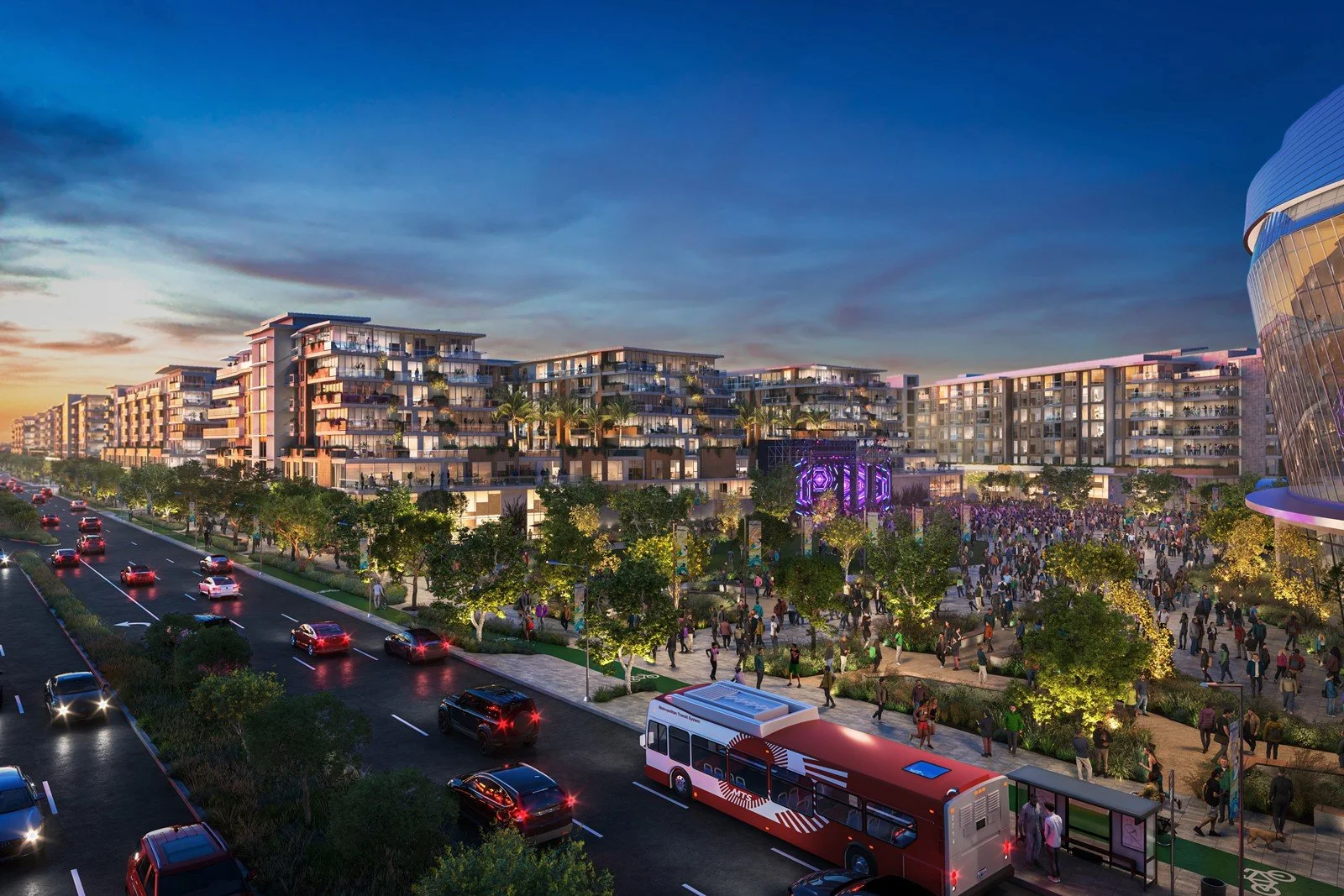
A pretty rendering doesn’t show the harms of congestion, lack of parking, and the financial giveaway to the developer.
Gov. Gavin Newsom has signed legislation removing significant legal obstacles facing San Diego’s massive Midway Rising redevelopment. But Sacramento cannot legislate away traffic, create parking spaces or determine whether San Diego is getting a good financial deal.
Midway Rising proposes 4,250 housing units, including 2,000 affordable units, a 16,000-seat arena, commercial development and parks on roughly 49 acres of publicly owned land.
Before San Diego commits this property for generations, two questions deserve answers: What will this project do to the surrounding community, and what will it cost the public?
Start with transportation.
Midway depends upon a constrained network of roads including Sports Arena Boulevard, Midway Drive, Rosecrans Street and West Point Loma Boulevard, with connections to Interstates 5 and 8.
Midway Rising would add thousands of residents while operating a regional entertainment destination accommodating 16,000 people.
Imagine residents returning home while thousands of arena patrons arrive for an evening event. What happens at surrounding intersections and freeway connections? What happens to emergency response? And what happens as additional Midway development adds still more vehicles?
The answer cannot simply be “take the trolley.”
The Old Town Transit Center is roughly three-quarters of a mile or more from portions of the site. That may be reasonable for an able-bodied commuter. It is less realistic for older residents, people with mobility limitations, parents with young children or thousands of arena patrons leaving an event late at night.
Then there is parking. Eliminating minimum parking requirements doesn’t eliminate cars. If parking is inadequate, vehicles don’t disappear. Drivers circulate through surrounding neighborhoods looking for spaces, potentially creating still more congestion.
Traffic is not the only environmental question.
Development of this magnitude raises issues involving noise, air quality, water and sewer capacity, stormwater, police and fire services, emergency access and the cumulative effects of additional development throughout Midway. The city’s environmental review itself addresses transportation, vehicle miles traveled, noise, geotechnical conditions and environmental site conditions.
Yet Sacramento has intervened with legislation substantially changing the legal landscape surrounding environmental challenges to Midway Rising. That makes the remaining City Council decisions more important, not less.
One of the biggest involves money.
Midway Rising has proposed an Enhanced Infrastructure Financing District, or EIFD, to capture future increases in property-tax revenue to help finance public infrastructure associated with redevelopment.
Tax increment is not free money. It dedicates future growth in property-tax revenues to specified infrastructure rather than allowing those revenues to flow as they otherwise would.
San Diegans therefore deserve to know exactly how much tax increment is proposed, how many years it will be committed, what infrastructure it will finance, which taxing agencies will participate and what happens if infrastructure costs exceed projections.
Then there is the biggest public asset of all: the land.
Nearly 49 acres of city-owned property are at stake. The city describes its process as exclusive negotiations intended to “fine-tune details,” followed by City Council consideration of a long-term lease.
Before voting, the city should release the complete proposed ground lease sufficiently in advance for meaningful public and independent financial review.
San Diegans should be shown the property’s fair-market value, proposed lease payments, length and escalation provisions, public subsidies and concessions, infrastructure obligations, tax-increment commitments, taxpayer exposure and consequences if the development fails to perform as projected.
There should also be a straightforward accounting of who pays for what.
How much does the developer invest? How much comes from future property taxes? How much infrastructure will the public finance? And what is San Diego receiving in exchange for committing one of its largest publicly owned redevelopment sites for generations?
Midway Rising’s supporters emphasize 2,000 affordable homes, a new arena and substantial public open space. Those are significant proposed benefits and belong in the discussion.
But benefits do not erase costs, and legislation does not erase real-world impacts. Sacramento can change the rules governing environmental review. It cannot shorten the walk to the trolley, create parking spaces, eliminate arena traffic or pay infrastructure bills.
Nor can Sacramento decide whether San Diego is receiving adequate value for nearly 49 acres of public land. Those questions still belong to San Diego.
Before the City Council commits the land, future tax revenues and San Diego’s future, it should put the entire deal on the table and give the public enough time to decide for itself whether the numbers — and the impacts — add up.
Chipman is founder of San Diegans for Responsible Planning.